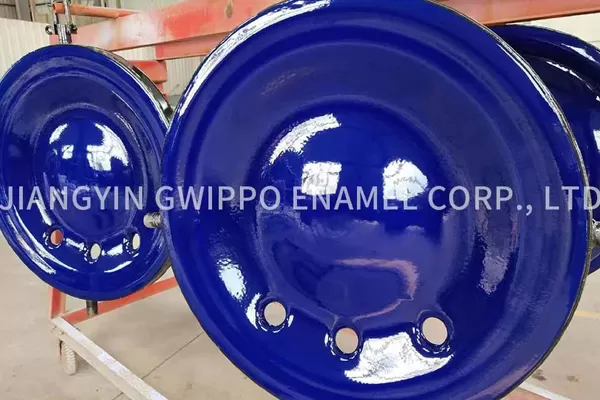
Porcelain explosion usually occurs in the parts of glass-lined products with a small radius of curvature, such as the arc of the container flange, the arc of the pipe connection plate or the arc of the lower liquid port. However, in some special cases, it may also occur in non-arc parts: if there are foreign objects on the surface of the porcelain layer that are not mutually fusible with the porcelain glaze and are not removed in time, and the spraying continues, the foreign objects are sandwiched between the two layers of porcelain glaze. The difference in thermal expansion coefficients between the two layers is large, which will cause stress at the interface, causing the porcelain layer to crack and fall off.
Causes of porcelain explosion:
(1) Metal matrix
Steel and cast iron are both rigid metals. They are not easy to deform permanently after being subjected to force. Therefore, due to the different expansion coefficients between steel and porcelain layers, expansion stress is generated, and the porcelain layer is easily damaged. Copper, silver, and aluminum are soft metals that are easy to deform after being subjected to force, and the porcelain layer is not easy to be damaged.
Steel and cast iron often cause metallographic changes during the enameling process. Phase changes cause changes in the expansion coefficient and generate stress. For example, the expansion coefficient of carbon in cast iron increases after graphitization, and the expansion coefficient also increases when pearlite is converted into austenite when steel is heated. Therefore, iron with pearlite as the matrix has a larger expansion coefficient than iron with ferrite as the matrix. Therefore, the change of the expansion coefficient of steel at various temperatures is not only related to the chemical composition but also to the metallographic structure. Different metallographic structures with the same chemical composition also have different expansion coefficients.
If the composition and expansion coefficient of the glaze remain unchanged, the expansion difference stress of the two will definitely increase or decrease when the glaze is applied on the iron tire with metallographic changes. At this time, cracks and porcelain explosions will appear in the porcelain layer. This phenomenon of cracks and porcelain explosions is particularly significant in cast iron enamel.
In addition, the metal surface treatment is not thorough, the oxide scale and dirt on the metal surface are not cleaned up, and the iron oxide affects the adhesion between the base glaze and the metal. The tool marks, grinding wheel marks, and too rough metal surface make the base glaze over-burned, that is, the base glaze is over-oxidized, and the poor adhesion causes the porcelain layer to fall off.
(2) Geometry of iron blank
Sharp corners should be avoided in the product structure, and arc transition should be adopted, and the radius of curvature should not be too small. The thickness of the two parts of the welded combination should not differ too much. Due to stress concentration and uneven stress distribution during heating and cooling, these stresses often damage the porcelain layer and cause it to fall off. Therefore, the radius of curvature should be increased as much as possible without affecting the pressing surface. Without affecting the strength of the pressure vessel, the thickness difference of each part of the iron tire should be kept as small as possible to minimize the stress caused by temperature difference during the enameling process due to unreasonable structure that damages the porcelain layer.
(3) Enameling operation
Control the firing time and firing temperature of the product to ensure that the base glaze and the metal surface react fully and ensure the close adhesion between the metal and the base glaze. Insufficient firing and incomplete close adhesion; too long firing time, too high temperature, burnout or over-firing of the base glaze, and supersaturation of iron oxide dissolved in the base glaze and precipitation of crystals (Fe2O3+ FeO =Fe3O4) deposited on the metal surface will all lead to poor close adhesion. Therefore, when firing, the firing time must be properly controlled according to the size and shape of the product under a certain temperature. When firing the first fire, you must closely observe the firing of the product in the furnace. You cannot mechanically look at the time without looking at the finished product. Often, the fired products are either too hot or too cold, which affects the product quality. Especially for new kilns, you should pay more attention.
The position of the product in the furnace should be appropriate to ensure uniform heating. If the heating is uneven and the temperature difference is large, the porcelain powder layer will easily fall off.
The thickness of the sprayed porcelain layer should be controlled uniformly. If the thickness of the porcelain layer is uneven, the heating and cooling wi

 CN
CN