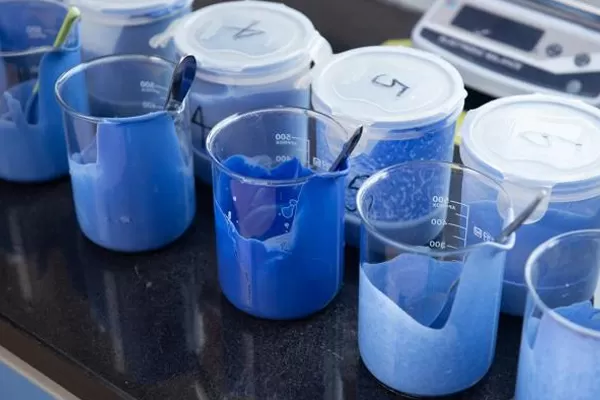
Wet dipping and wet spraying are established methods for applying enamel slurry to steel water-heater tanks and components. Both require controlled preparation, drying and firing to produce a vitreous coating. The practical choice depends on access to the internal surfaces, drainage, equipment, production volume and coating consistency. Select the enamel formulation together with the application process.
What Are Wet Dipping and Wet Spraying for a Glass Lined Water Heater Tank
Wet dipping brings the component surfaces into contact with enamel slurry by immersion, followed by controlled withdrawal and drainage. For internal glass lined tank surfaces, the equipment must allow slurry to reach the surfaces and displaced air to escape. Wet spraying deposits slurry through a nozzle or spray lance. Both processes are followed by drying and firing.
Dipping depends on immersion orientation, air release, withdrawal and drainage. Spraying depends on nozzle access, flow rate, spray pattern and relative movement between the nozzle and tank. In air-atomized systems, compressed air breaks the slurry into droplets; the atomization settings must match the slurry and equipment.

Wet Dipping vs Wet Spraying Key Differences in Production
Wet dipping emphasizes complete contact between the workpiece and slurry, while wet spraying provides more localized control over where material is deposited. Neither method is automatically superior; process stability and tank design determine the practical result.
Factor | Wet Dipping | Wet Spraying |
Application | Immersion with internal access and air release where required | Slurry atomized through spray equipment |
Coverage control | Influenced by immersion and drainage | Influenced by nozzle, flow and movement |
Complex geometry | Good surface contact, but drainage matters | Targeted access, but blind spots must be controlled |
Material control | Slurry recovery and drainage are important | Overspray and transfer efficiency matter |
Automation | Immersion handling and tank movement | Spray lance/nozzle and tank movement can be automated |
For quality evaluation, ISO 4528:2022 provides guidance on selecting test methods for vitreous and porcelain enamelled articles. This supports evaluating the finished coating rather than judging the application method only by equipment configuration.
Which Process Variables Matter Most for Coating Quality
Coating quality is determined by the complete process: steel preparation, slurry properties, application, drying, firing and inspection. A stable application method cannot compensate for poor pretreatment or an unsuitable firing profile.
Control slurry density, viscosity, temperature, suspension stability and milling fineness, using agreed measurement methods. Also control deposited thickness, drying and the complete firing cycle. Use the selected enamel grade's technical data sheet for temperature and time, and confirm the actual workpiece temperature rather than relying only on the furnace setpoint.
Tank geometry is also important. Deep sections, openings, welds and curved transitions can affect drainage in dipping and spray access in spraying. Defects can also originate from contamination or poor water quality during slurry preparation, so process control must extend beyond the application equipment.
Confirm the coating construction before comparing processes. Direct-on enamels are designed to bond to suitably prepared steel without a separate ground coat.
How Should Manufacturers Choose Between Dipping and Spraying
The appropriate process is the one that provides repeatable coverage and acceptable material use within the manufacturer's production conditions. Dipping can be attractive when immersion and drainage are easy to control, while spraying can offer more direct control of local coverage and is well suited to automated spray movement.
Compare adherence using an agreed test method and representative specimens. ASTM B916 covers adherence testing of porcelain enamel coatings to sheet metal and can be relevant when the substrate and coating system fall within its scope. Coupon results should be supplemented by inspection of actual tanks, especially around welds, openings and transitions.
Before changing processes, compare coating thickness, defect rate, material consumption, drying time, firing results and inspection data on actual tanks. A supplier should also receive the tank dimensions, steel grade, production volume, existing furnace profile and required performance targets.
Conclusion
Choose the process that consistently meets the tank specification under the available production conditions. Dipping requires reliable wetting, air release and drainage; spraying requires reliable nozzle access and controlled deposition. Compare the two through production trials using the same acceptance criteria for coverage, thickness, defects, adherence and hot-water durability.
FAQ About Wet Dipping and Wet Spraying
Is wet dipping better than wet spraying for water heater tanks
Neither method is universally better. The result depends on tank geometry, slurry behavior, equipment and process control.
Can wet spraying coat the entire inside of a tank
Yes, when the spray lance, nozzle arrangement and tank movement provide adequate access. Coverage should be verified on difficult areas.
How should the firing temperature be selected
Follow the technical data sheet for the selected enamel grade and validate the temperature and holding time on representative tanks. The required cycle depends on formulation, steel thickness, loading and furnace performance; one temperature range should not be applied to all products.
Does wet dipping use more enamel than wet spraying
Not necessarily. Consumption depends on film thickness, drainage, slurry recovery, transfer efficiency and process settings.
What can cause poor enamel adhesion
Possible causes include inadequate steel preparation, unsuitable enamel formulation, uneven application and an inappropriate firing profile.
What information should be provided when selecting enamel
Provide tank dimensions, steel grade, application method, slurry conditions, production volume, furnace profile and required coating-performance targets.

 CN